

Your spreadsheet is a graveyard of outdated data, not a roadmap. For a founder, managing a portfolio that spans company equity, private investments, crypto and traditional accounts has become a full-time job you never applied for — and every hour spent reconciling tabs is capital stolen from your next move. You don't need another tracker. You need a strategic cockpit: wealth management software that has evolved from passive reporting into a live intelligence layer built for the velocity of entrepreneurship.
Here is the paradox every high-achiever hits: as your success scales, your financial visibility shrinks. This article shows how to move from manual tracking to automated wealth intelligence — how read-only data syncing gives you total oversight, and how an AI assistant grounded in your real holdings turns that oversight into decisions.
Key Takeaways
- Static reporting is obsolete: live intelligence layers have replaced the Sunday spreadsheet for founders.
- Modern wealth software connects through secure, read-only protocols — it can see your accounts, never move your money.
- Fragmented holdings — private equity, real estate, crypto, physical assets — belong in one dashboard, classified by what they are.
- Security and pricing are the two criteria that separate a real platform from a legacy tool in 2026.
- The Capital Efficiency Score moves you from passive tracking to active capital optimization.
The Evolution of Wealth Management Technology
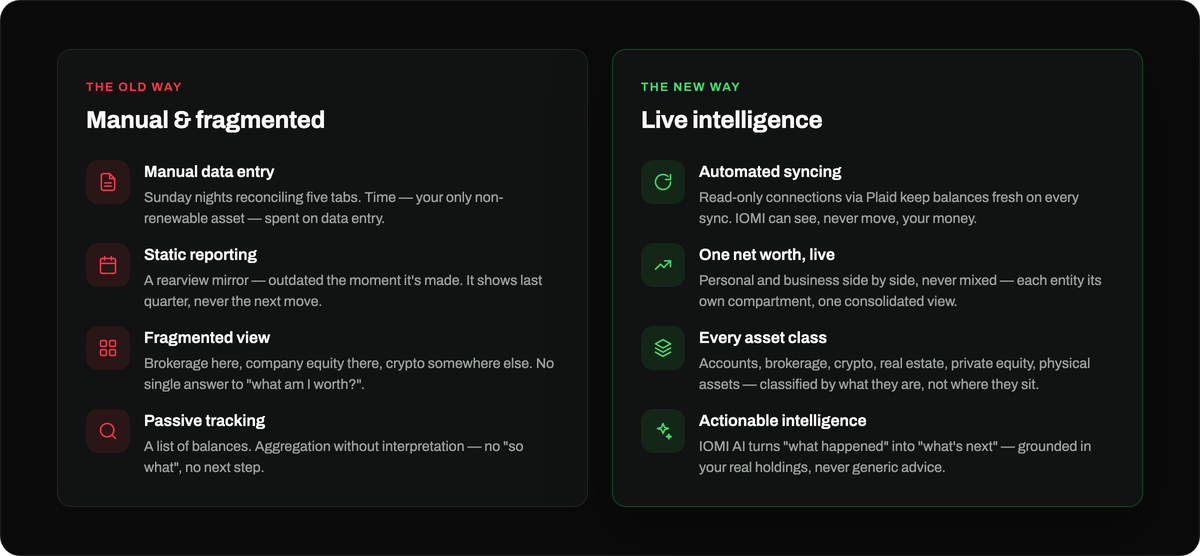
Traditional wealth management was a rearview mirror: it told you where you were last quarter and nothing about where to go next. For a founder, that delay is a recipe for stagnation. Modern wealth management software sits above your accounts — syncing, classifying and calculating continuously — so the question "what am I worth, right now, across everything?" has an answer at any moment. Static reporting is dead; live visibility is the standard. (If you want the short version of why a purpose-built tool beats a general AI chatbot for this job, read Why IOMI.)
Spreadsheets are now a liability: brittle, manual, slow. If you still spend Sunday nights reconciling transactions across five tabs, you are trading your most valuable asset — time — for data entry. The industry has shifted to read-only transparency: through secure protocols like Plaid, modern systems refresh your balances on every sync without ever holding the authority to move a dollar.
From Data Aggregation to Wealth Intelligence
Aggregation is a list. Intelligence is a strategy. Seeing your data is no longer enough when your portfolio spans private equity, crypto and brokerage accounts — you need interpretation. An AI assistant that reads your actual holdings can surface what human eyes miss: the idle cash dragging your returns, the concentration you stopped noticing, the goal that has quietly slipped off pace. It works while you build, and it replaces the spreadsheet ritual with a dashboard that reflects your true net worth.
The Founder's Financial Profile
Founders aren't retirees. Your financial life is an aggressive, high-velocity intersection of business equity and personal liquidity — and it doesn't look like a passive index-fund portfolio. You need to simulate a move before you commit to it. You need to know how a planned cash outflow next year affects the liquidity you'll have for a new venture. And you need personal and business kept side by side, never mixed: your company's balance sheet is not your personal one, but your ownership in it is part of your net worth. Modern wealth software that understands this cadence is a cockpit for people who value compounding over conservation.
Core Pillars of a Modern Wealth Intelligence Platform
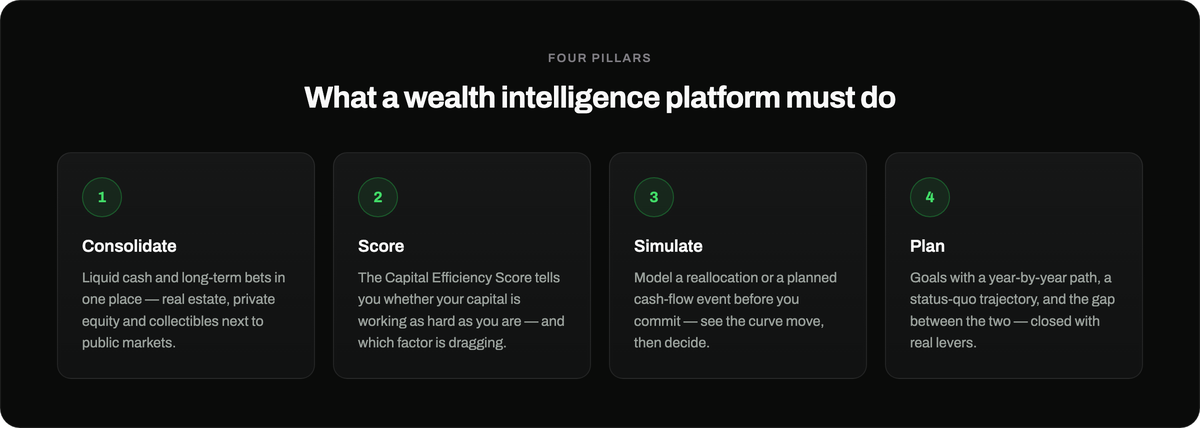
Visibility is the baseline; intelligence is the objective. A serious platform doesn't just list balances — it synthesizes them into a strategic narrative. Four pillars are non-negotiable: automated, read-only integration; one consolidated net worth; a score that tells you how well capital is deployed; and AI that is actionable because it is grounded in your data.
Total Asset Consolidation
Most founders hold wealth across a dozen silos. Bank and brokerage accounts are the easy part; the real challenge is the illiquid and the alternative. A modern platform must bridge liquid cash and long-term bets: private equity and angel investments next to public markets, real estate valued automatically, physical assets — a watch, a car, a collection — tracked as the stores of value they are. And it must classify each holding by what it is, not where it sits: crypto held at a broker is crypto, not "brokerage". When every asset class lives in one dashboard, the cognitive load of fragmented wealth disappears.
The Intelligence Layer: AI and Scoring
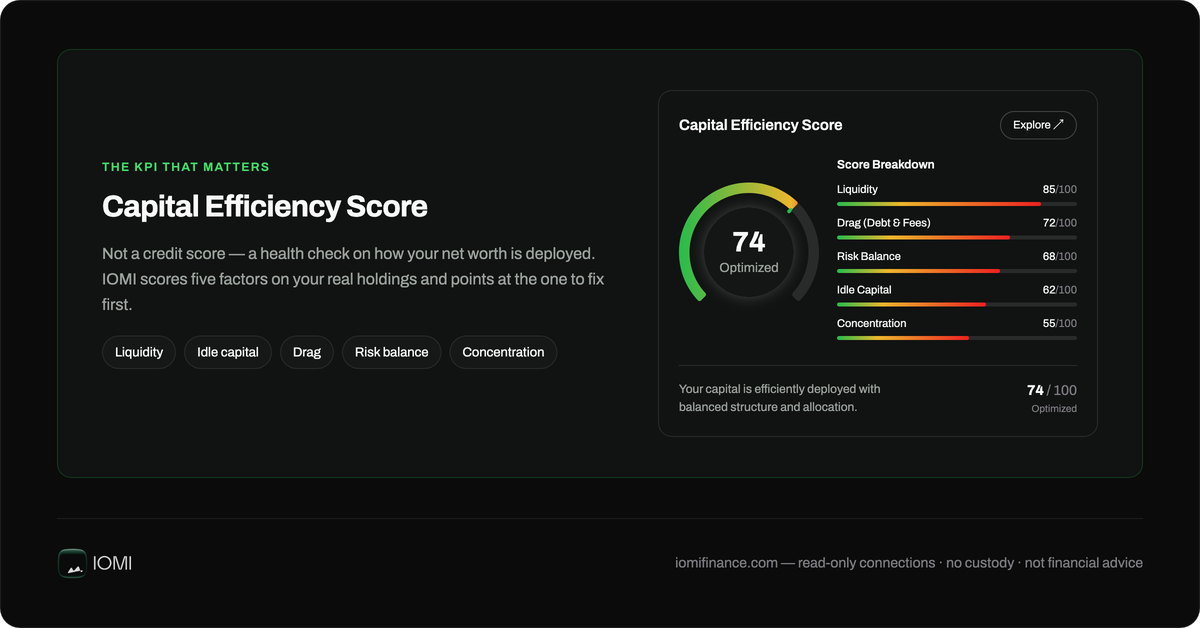
Once data is consolidated, the system must work for you. The most useful advance in wealth software for 2026 is the Capital Efficiency Score — not a credit score, but a health check on how effectively your capital is deployed across your entire net worth. IOMI scores five factors on your real holdings — liquidity, idle capital, drag, risk balance and concentration — and points at the one to fix first. It transforms "what happened" into "what's next".
Simulation takes this further. You shouldn't have to guess the impact of a major move. Whether you are weighing a reallocation between asset classes or a significant planned cash-flow event, you can model the outcome on your own projection before you execute. That "simulate before committing" step provides certainty a spreadsheet can't. If you're ready to move from passive tracking to active optimization, see how IOMI does it.
Solving the Fragmentation of Alternative Assets
Fragmentation is a silent tax on your attention. You shouldn't hunt for your net worth across five exchanges and three private-equity portals. For the modern builder, wealth is rarely liquid or traditional — it's diverse, volatile and scattered. Effective wealth software acts as a universal translator between those asset classes. If your tools can't see your whole world, they aren't tools; they're blind spots.
Bridging the Gap Between Crypto and Traditional Finance
Crypto is no longer a side experiment for many founder portfolios. Consolidating exchange accounts and wallets into one view, with live pricing, is essential — without it your net worth is a guess, not a fact. You need to see how a Bitcoin move changes your total liquidity and your concentration. Security stays the priority: read-only connections mean your digital assets remain in your custody while you get the visibility you need.
Private Equity and Business Assets
The missing piece for most high-achievers is often their largest holding: private equity — pre-IPO shares, angel tickets, or equity in the company you are building. You cannot manage what you don't measure. By tracking your business entities — their accounts, their net assets, your ownership percentage — alongside your personal holdings, you get the "owner view" of your financial life: exit potential next to liquid cash, your true risk profile in one picture. The discipline that matters is separation with visibility: business and personal never mixed, but both always in the frame.
High-value physical assets — fine art, rare timepieces, vehicles — are usually excluded from traditional reporting. That's a mistake: they're stores of value that belong in your capital-efficiency picture. A unified view must account for them to be complete.
Evaluating Your Tech Stack: Selection Criteria for 2026
Choosing wealth management software is a strategic decision, not a tactical one. You aren't buying a tool; you're choosing an intelligence partner. Legacy platforms suffer from feature bloat and interfaces that feel like the 1990s. For a founder, speed and clarity are paramount — insights in seconds, not a spreadsheet-style grid that needs a manual. The market is moving away from AUM-based pricing, where you are penalized for your own growth, toward transparent subscriptions that align with your interests. If a platform still charges a percentage of your assets to show you your own data, it's time to move on.
Privacy and Security Protocols
Security is the foundation of every financial decision. The gold standard for wealth tech in 2026 is read-only access: the software pulls data for analysis without ever having the authority to move or withdraw funds. When evaluating a platform, check three things — that connections are read-only, that your bank credentials are never stored by the platform (Plaid handles the authentication), and that the platform does not offer brokerage or custody. A tool that tries to be both your tracker and your broker creates unnecessary risk and conflicts of interest. Keep intelligence and custody separate: your principal stays with your institutions, your visibility lives in the platform.
Scalability and Future-Proofing
Your net worth is dynamic; your software must be too. A tool that works at seed stage often breaks at an exit or a series of venture commitments. Look for a system that scales with complexity: multiple business entities, goals with year-by-year plans, cash-flow forecasting that feeds your projections, and an AI assistant whose answers get more accurate as your data history compounds. It should flag inefficiencies and suggest optimizations before you notice them yourself.
Fragmentation is the enemy of compounding. If you're ready to upgrade your financial oversight to a system built for the modern builder, get started with IOMI — one-month free trial, no credit card required.
IOMI: The Intelligence Layer for High-Achievers
Institutional engines feel like they were built for the back office of a global bank — bulky, slow, disconnected from a founder's reality. IOMI is the antithesis of that: a live intelligence layer for high-achievers that moves you from cognitive load to total oversight. You're a builder. You deserve a platform that speaks your language and respects your time.
The IOMI Dashboard Experience
The interface is minimalist and fast. It consolidates your bank accounts, brokerage, crypto, real estate, company equity and physical assets into a single view, with a Personal/Business toggle so each entity stays its own compartment. The Capital Efficiency Score gives a live health check on the whole ecosystem — is your money working as hard as you are? Insights explain the score factor by factor; the Forecast shows your net cash flow ahead; the Projection turns today's holdings into a year-by-year path; Goals measure you against it.
Taking Control of Your Financial Narrative
IOMI AI is the assistant that reads your real holdings — not a generic chatbot. It answers with your numbers, never estimates when data is missing, and points you to the lever that matters. You can simulate reallocations and planned cash-flow events to see the impact on your trajectory before you act. This isn't just automation; it's the ability to scale your wealth with the same precision you bring to your company.
The era of manual tracking is over. You need a system as ambitious as your goals. Stop looking at where you were and start seeing where you can go. Experience wealth intelligence with IOMI and take your seat in the cockpit.
Command Your Capital Legacy
Managing a high-growth portfolio in 2026 requires more than a spreadsheet; it requires a live intelligence layer. The right wealth management software transforms disorder into oversight: it bridges liquid cash and alternative assets, replaces cognitive load with clarity, and gives you the visibility to move with speed. By focusing on your Capital Efficiency Score, you move from passive conservation to active compounding — while IOMI AI watches for idle capital as you lead your company. Transparent pricing (Personal $29/mo, Business $39/mo, one-month free trial), read-only connections, no custody. Master your wealth with IOMI.
Frequently Asked Questions
What is the difference between a net worth tracker and wealth management software?
A tracker is a rearview mirror; wealth management software is a live cockpit. Trackers record where you were; an intelligence platform interprets where you're going — syncing data continuously, scoring how well capital is deployed, and suggesting next moves. One is static; the other is strategic.
Is wealth management software safe for founders to use?
It is when it's built read-only. Leading platforms connect through Plaid, which means the platform sees balances and transactions but holds no authority to move funds or execute trades — and never stores your bank credentials. By separating visibility from authority, you get total oversight without increasing your risk.
How does AI improve wealth management for entrepreneurs?
A grounded AI assistant turns raw data into decisions: it identifies capital that isn't working, explains which factor is dragging your efficiency score, and lets you simulate a move before you make it. For entrepreneurs, that means objective, data-driven insight without the manual analysis — across personal and business holdings.
Can I track my private equity and crypto in one dashboard?
Yes. The best platforms consolidate exchange accounts and wallets, private investments and company equity into a single net worth view — and classify each holding by what it is, so crypto held at a broker counts as crypto. You see how a volatile asset affects your total liquidity and concentration in one picture.
What is a Capital Efficiency Score and why does it matter?
It's a health check on how effectively your assets are deployed — not a credit score. IOMI's version scores five factors on your real holdings: liquidity, idle capital, drag, risk balance and concentration. For founders it's the metric that balances business reinvestment against personal liquidity and keeps capital compounding instead of sitting idle.
Do I need a financial advisor if I use wealth intelligence software?
Software doesn't replace an advisor; it makes you a better-informed client. Wealth management software handles the granular, real-time data so your conversations with professionals start from facts. Note that IOMI is educational — it is not a bank, broker or financial advisor and does not give personalized investment advice.
How does read-only access protect my financial accounts?
Read-only access is a one-way street for data: the software can view and categorize your balances and transactions, but it has no credentials to initiate transfers or change account settings. Even in a worst case, your funds stay untouched inside your primary institutions. Visibility without vulnerability.
Why should founders move away from spreadsheets for wealth tracking?
Spreadsheets are brittle, manual and prone to error — a drain on time and attention that leads to outdated figures and missed moves. An automated intelligence layer gives you accuracy a static file can't, ends the Sunday ritual, and scales with your success.
IOMI is not a bank, broker or financial advisor. It does not custody assets, execute trades or provide personalized investment advice. All outputs are educational.